Solutions Scenarios & delivery
Where the pod wins
A solution without a scenario is a brochure. We start from the engineering case you're actually in — the chip generation you're buying, the power you already hold, the water you don't have — and the same model we run our own capital through decides the verdict. Every scenario below links the products inside it, the technology behind it, and the kill condition that would stop the deal.
Scenarios · engineering cases
Pick your case
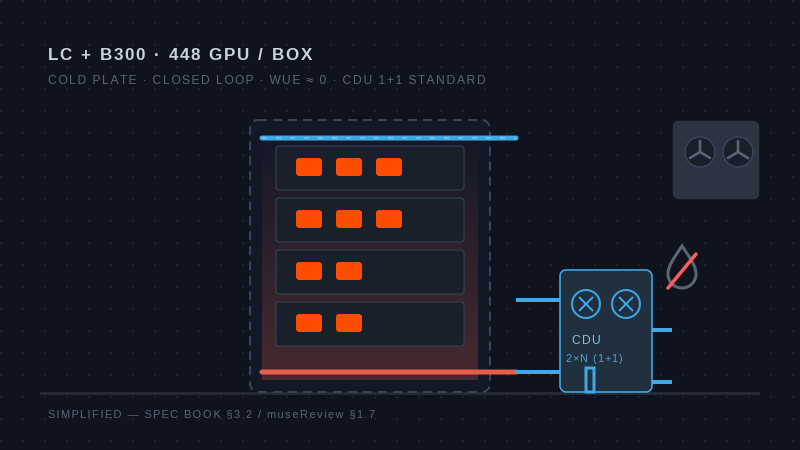
B300 liquid training pod
448 GPUs in one 40-ft box, 1+1 CDU, zero process water. The config math, the leak-discipline kill condition, and the 3-year TCO crossover.
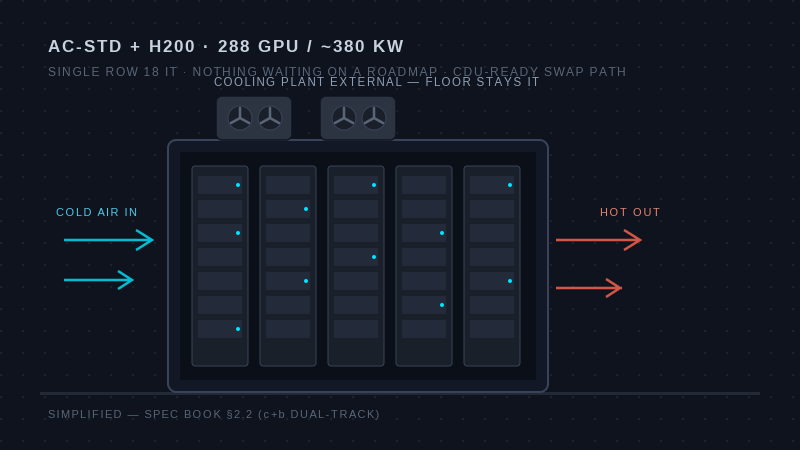
H200 fleet, air first
288 GPUs at ~380 kW, mature hardware with nothing waiting on a roadmap — and the CDU-ready swap path when NVL72-class refresh cycles arrive.
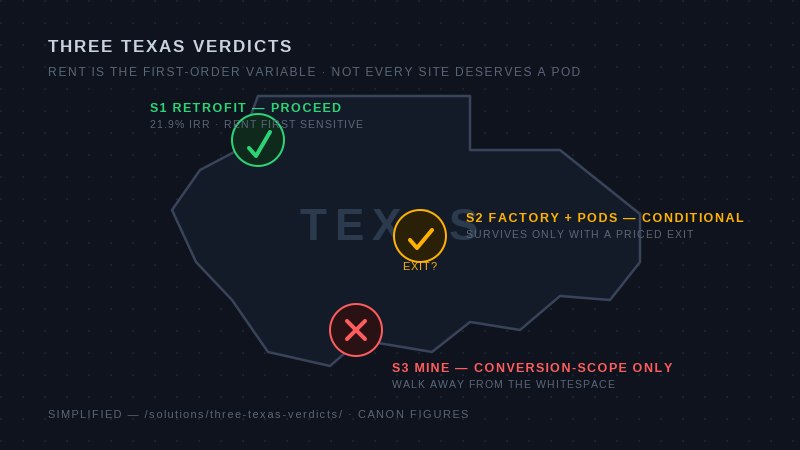
Three Texas site verdicts
Retrofit, factory-plus-pods, mine conversion — the rent-sensitive arithmetic behind PROCEED, CONDITIONAL, and walk-away calls.
Estimator
Size it in three lines. GPU count → IT kW → facility power → capex band. The white paper with the lookup table.
After go-live
US operations & support. Remote NOC 7×24, quarterly PM, in-country spares — the turnkey promise after the truck leaves.
On the record
The technical library. Every brief with its docType, assumptions and low-confidence flags.
Delivery paths
Three ways to land a megawatt
The full arithmetic →Retrofit
Energize white space you already hold. $4.25M all-in per MW, 21.9% base IRR — PROCEED. Kill: the "spare" power must survive due diligence.
Pod deployment
Buy the time premium. 6–9 months signature → power bill, $3.6–4.9M/MW·IT with duty. Kill: priced on the bull case — we walk.
Site conversion
Mines and powered industrial sites. Scope-frozen: light retrofit $1.5–3.6M/MW proceeds, full AI-ready $10.25M+ never clears our hurdle.
On the record
Briefs & technical references
The library →What the literature actually says about container data centers
Eleven open-access papers that back the claims on this site — AI power demand, the US data-center footprint, cooling-chain thermodynamics, and PUE benchmarks — with DOIs and what each one supports.
The Pod Is Now an NVIDIA Product
With DSX POD, NVIDIA standardized the factory-built container AI factory — liquid-cooled, 800VDC, GPUs included. For a seller of empty pods that is endorsement and deadline at once: the form factor is validated, the generational window is closing, and the customers NVIDIA cannot serve are exactly ours.
Plan A — The H200 Air-Cooled Row, Spec'd
Two 8-GPU H200 servers per cabinet, ~21 kW IT, sealed cold aisle, fluorine-pump free cooling. The full working paper: per-layer sizing, power chain, honest gaps, kill condition.
Plan B — The B300 Liquid-Cooled Row, Spec'd
Four 8-GPU B300 servers per cabinet, ~55 kW IT, cold plates, fluorine-to-water CDU, dry coolers. The full working paper: loop math, CDU sizing, power chain, kill condition.
How to spec and price a container data center (2026)
A customer-facing whitepaper: two container products (air / liquid), four chip configurations (H200 / B300 in each), per-container GPU counts, and a three-line estimate you can run from your GPU count. Infrastructure capex only, every assumption labeled.
The Three-Layer Waterfall: Megawatts, GPU-Hours, Tokens
One megawatt, three revenue layers: $2.3M of rent, $25M of GPU-hours, unbounded tokens. Revenue scales 10× and volatility 100× — we hold the only layer with a signed lease.