Scenario Engineering case · air first
H200 fleet,
air first
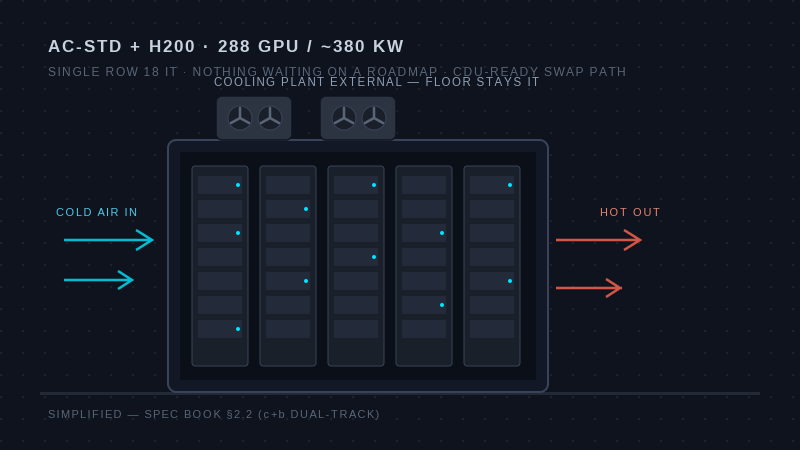
The case: your fleet is H200 (or air-node B300), your site has 480 V service and no water to spare, and you value bankable over bleeding-edge. Air is the fastest, simplest path — every component is mature, nothing waits on a roadmap. The honest ceiling is the box's heat-rejection budget, not its floor plan: ~380–400 kW for dense GPU fills, which is why "0.4 MW class" is the whole air story and the market norm is 170–300 kW.
What's inside · products
Product
FDC-P40-AC — the air-cooled container: single-row 18 IT, external DX/FC plant, no water anywhere. A wind-wall flagship follows verification ◐.
Accessories
Rooftop DX / fluorine-pump FC units, PDC/busway, optics + MPO trunks per server QVL — bundled, pre-tested at FAT.
Money
$3.6–4.9M/MW·IT landed, duties included (before duties $2.8–4.0M) — air's capex advantage holds for 60–80% utilization hosting.
Tech behind · technology
Technology
Three cooling chains — where air sits against fluorine-pump free cooling and liquid, with the figures to argue it.
Technology
MV → LV power chain — what one low-voltage feeder actually carries, with the campus substation anatomy.
Memo
Air-cooled B300 — four OEMs shipping air nodes since 2025-03, the performance tax measured, the 60–70 kW/rack ceiling.
The full brief · on the record
The configuration working paper for this scenario — 2 servers/rack at 21 kW, why the GPU count drops as racks run hotter, the FC-variant free-cooling arithmetic — is the modular air + H200 solution brief. The product spec lives on the FDC-P40-AC page; siting math is in the three Texas verdicts.
Kill conditions: free-cooling hours below ~50% → drop the FC variant, take plain DX. NVL72-class systems or sustained loads above 30 kW/rack → that's not this box — go liquid.