Flare delivers modular AI data centers.
Megawatts,
moved like cargo
Energized in weeks — earning in months
American labor is scarce and power is scarcer. We build complete AI data centers inside standard 40-ft containers — factory-assembled, shipped by truck, running weeks after the pad is poured. The industry calls one of these units a pod; ours is the FDC-P40 — FlareDC Pod, 40-ft. Land one low-voltage feeder, plug in fiber, and your GPUs mint tokens the same quarter: rent now, refi or sell the stabilized asset later. Every quote ships with the per-megawatt math that brochures leave out.
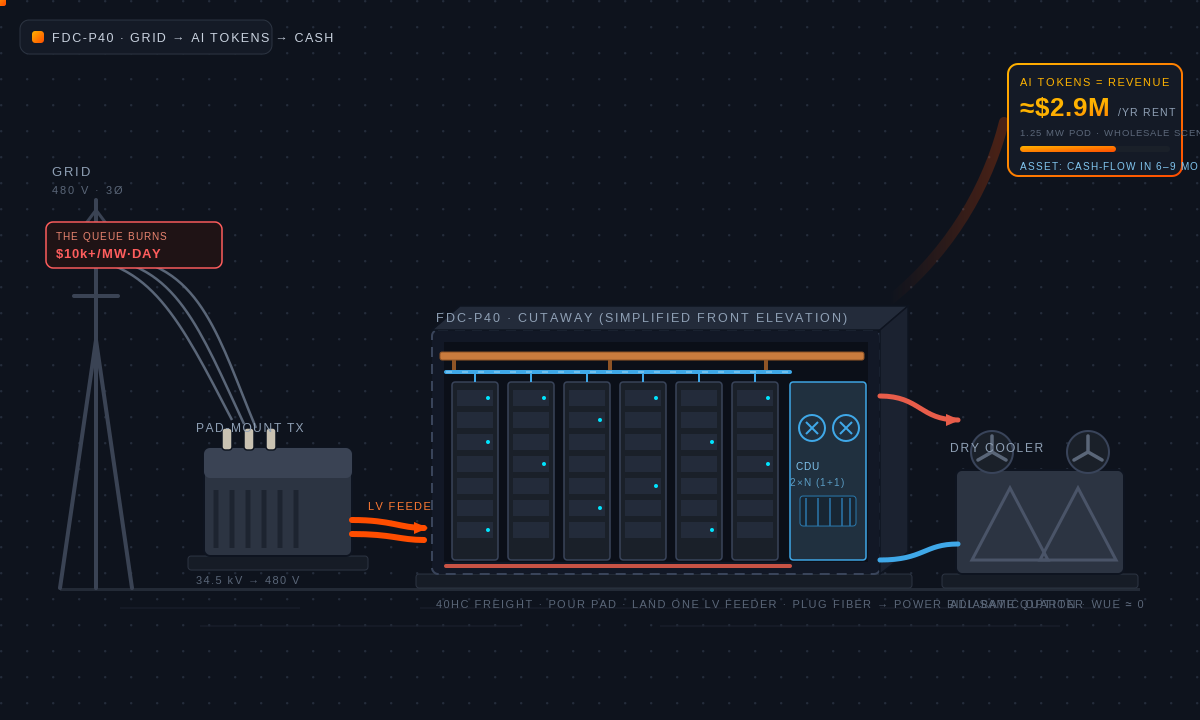
Numbers we keep coming back to
The honest math
The product
FDC-P40 — the turnkey pod
Full specs →AC
Air-cooled. 350 / 450 / 540 kW of IT in a single-row 18-rack floor plan, 8–30 kW/rack, PUE 1.40–1.50. A 27-rack wind-wall flagship (500–750 kW) follows third-party verification ◐.
LC
Liquid-cooled. 850 / 1,050 / 1,250 kW, 50–132 kW/rack, PUE 1.15–1.20, closed loop — CDU 1+1 whole-unit backup standard. For NVL72-class racks.
3
Customer moves, total. Pour a pad, land one low-voltage feeder, plug in fiber. Power bill the same month, rent the same quarter.
Scenarios · engineering cases
Where the pod wins
All scenarios →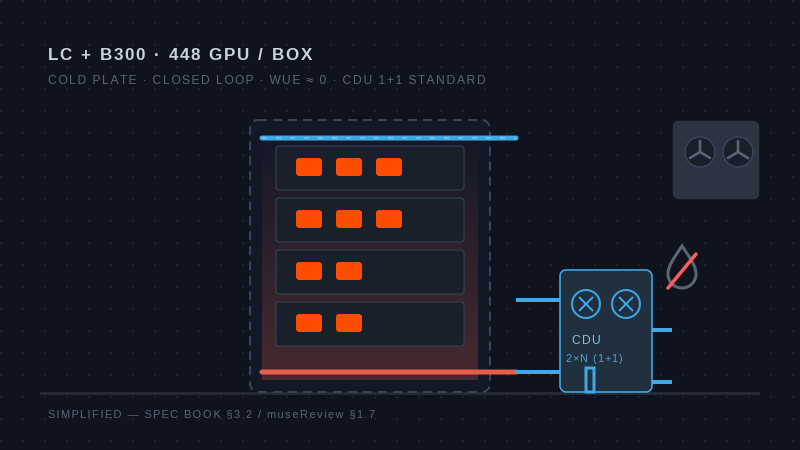
B300 liquid training pod
448 GPUs in one 40-ft box, 1+1 CDU, zero process water. The config math, the leak-discipline kill condition, and the 3-year TCO crossover.
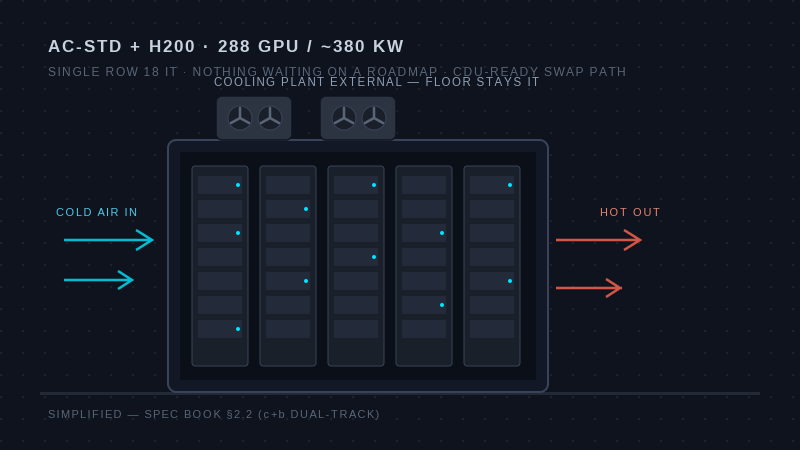
H200 fleet, air first
288 GPUs at ~380 kW, mature hardware with nothing waiting on a roadmap — and the CDU-ready swap path when NVL72-class refresh cycles arrive.
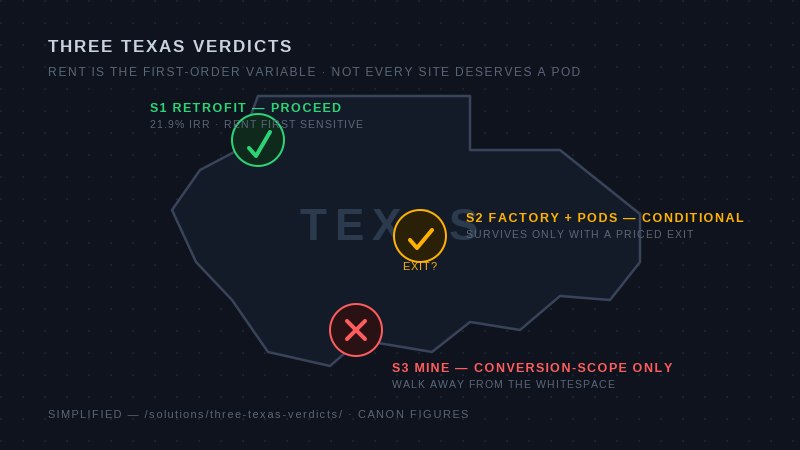
Three Texas planning scenarios
Planning scenarios, not executed projects: retrofit, factory-plus-pods, mine conversion — the rent-sensitive arithmetic behind PROCEED, CONDITIONAL, and walk-away calls.
One system, three entrances
Products
FDC-P40 air & liquid pods, plus the factory-installed accessory line — optics, MPO fiber trunks, PDC, UPS bay, CDU. Specs, delivery, price ladder.
Technology
Three cooling chains, the MV→LV power anatomy, 800 VDC roadmap. Field-level interactive figures with sources on the record.
Solutions
Scenarios first — where the pod wins and where it doesn't — then the three delivery paths and the US operations team behind every deployed site.
Live-ish · the power queue
Where power still says yes
Dallas · ERCOT
42
CAUTIONHouston · ERCOT
43
CAUTIONASHBURN · PJM
20
AVOIDSanta Clara · CAISO
44.2
CAUTIONPhoenix · WECC
43.5
CAUTIONChicago · PJM
21.9
AVOIDATLANTA · SOCO
20.7
AVOIDDCPI power-availability composite (0–100) for seven flagship US markets — DCPI 42/100 — CAUTION format. Composite is a modeled estimate (medium confidence, 2026-11-01); sub-scores and exact MW are pro-tier. Pipeline bands: TX 10–50 GW · VA 1–5 GW · CA 500 MW–1 GW. Data: DC Hub DCPI, CC-BY-4.0, updated 4×/day. Verdict = outlook for new power in that market, not market quality.
On the record
Latest briefs
The library →What the literature actually says about container data centers
Eleven open-access papers that back the claims on this site — AI power demand, the US data-center footprint, cooling-chain thermodynamics, and PUE benchmarks — with DOIs and what each one supports.
The Pod Is Now an NVIDIA Product
With DSX POD, NVIDIA standardized the factory-built container AI factory — liquid-cooled, 800VDC, GPUs included. For a seller of empty pods that is endorsement and deadline at once: the form factor is validated, the generational window is closing, and the customers NVIDIA cannot serve are exactly ours.
Plan A — The H200 Air-Cooled Row, Spec'd
Two 8-GPU H200 servers per cabinet, ~21 kW IT, sealed cold aisle, fluorine-pump free cooling. The full working paper: per-layer sizing, power chain, honest gaps, kill condition.
The company
Who we are
About →FlareDC builds modular AI data centers — complete FDC-P40 pods engineered against a published specification book, shipped by truck, and energized in weeks. Based in Houston, TX, we hold one layer — the infrastructure — and put the per-megawatt math on the record in every quote.
More about the companyNews
2026-11-02 Eleven open-access papers now back the claims Density ladder, PUE, grid-queue and CDU anchors — each with a falsifier line. 2026-11-02 AI runs the routine: the operations layer Predict, see, optimize, defend — the AIOps stack behind every deployed site. 2026-11-02 Component line published Optics, MPO trunks, PDC, UPS bay, CDU — factory-installed accessories with specs. 2026-11-01 NVIDIA enters the pod business What DSX POD means for modular buyers — and the lane it leaves open. 2026-10-31 The cost reference, reconciled Model band, quote band and landed caliber — one document, all three on the record.Next step
Quote in three questions
Contact →Servers
What servers? 2U/4U air-cooled → AC version. NVL72-class or cold-plate → LC.
Power
What power do you hold? 380/480 V → direct-in. Only MV → transformer variant, priced up front.
Tier
What tier? Default ≈ Tier I, liquid plants 1+1 by default. Tier II–III itemized in writing.