Technical reference
What the literature actually says about container data centers
Our product pages make engineering claims: grid queues stretch years, liquid cooling unlocks 2–2.5× rack density, PUE bands differ by cooling chain, water-free operation is a siting argument. The vendor brochures and our own models carry those numbers day to day — this page is the academic layer underneath: eleven open-access papers, found via structured searches of the OpenAlex scholarly index (retrieval date 2026-11-02), each mapped to the claim it supports.
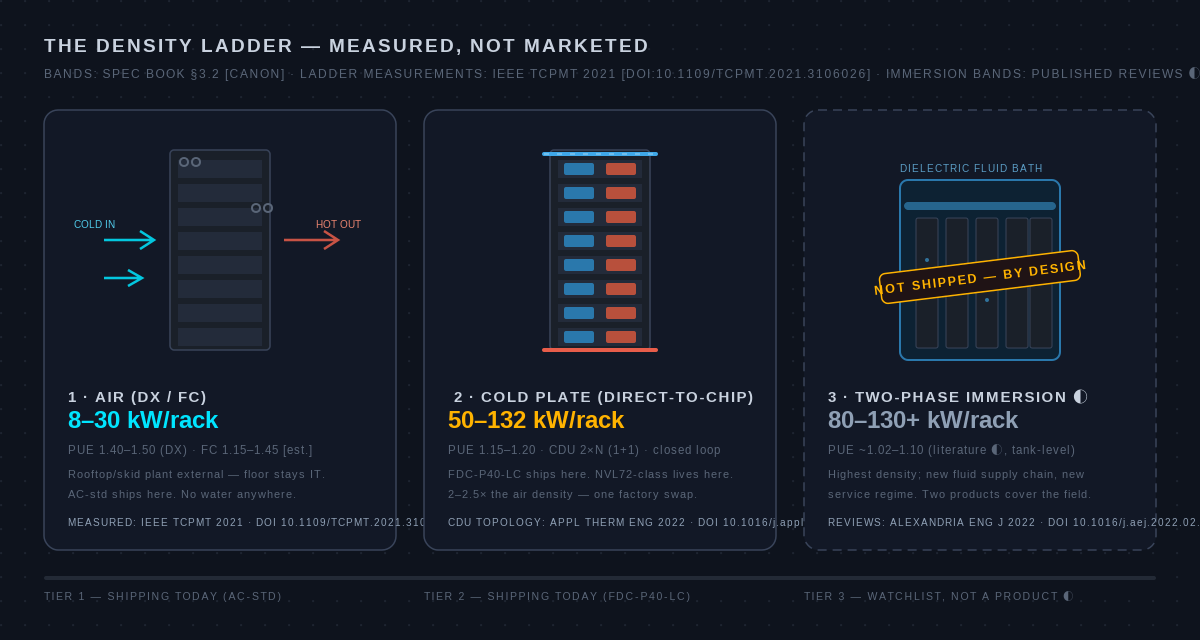
The measurement tiers are drawn — literally — in the density ladder: three cooling regimes, their rack-density bands, and what each tier ships today.
Two honesty notes before the list. First, this is an open-access scan — IEEE’s paywalled corpus is excluded except IEEE Access; the ASHRAE TC 9.9 thermal guidelines we cite elsewhere are still referenced secondhand. Second, citation counts are a snapshot of the retrieval date; they measure attention, not truth. What each paper “supports” is our mapping, not the authors’ endorsement.
Power is the asset
Will Energy-Hungry AI Create a Baseload Power Demand Boom? — IEEE Access, 2024. AI workloads as a structural baseload demand driver, not a burst load. The premise every quote on this site starts from.
Falsifier: utility filings showing AI load growth absorbed without new firm capacity — would undercut the power-is-the-asset premise.
Electricity demand and grid impacts of AI data centers: Challenges and prospects — Nexus (Cell Press), 2026. Grid interconnection delay and impact analysis for AI-scale loads. The multi-year queue our “weeks, not years” pitch is set against is an industry-grade problem, documented.
Falsifier: interconnection queues clearing in months at AI scale — would reprice “weeks, not years” from edge to nicety.
The footprint makes siting an argument
The environmental footprint of data centers in the United States — Environmental Research Letters, 2021. US data-center energy and water footprint at state resolution. The backdrop for our WUE ≈ 0 and zero-water siting claims: in water-stressed counties, the numbers are public and the scrutiny is real.
Falsifier: a US state-level dataset showing DC water consumption decoupled from local stress — would soften the zero-water siting claim.
The three cooling chains, reviewed
Thermal Management and Energy Consumption in Air, Liquid, and Free Cooling Systems for Data Centers: A Review — Energies, 2023. The academic version of our three-chain analysis: air, liquid, and free cooling each carry a thermal envelope and an efficiency cost.
Falsifier: a cooling chain combining air economics with liquid density at scale — would collapse the two-product line into one.
CPU Overclocking: A Performance Assessment of Air, Cold Plates, and Two-Phase Immersion Cooling — IEEE TCPMT, 2021. Measured density ladder — air, then cold plates, then two-phase immersion. This is the physics behind our 8–30 kW/rack air band versus the 50–132 kW/rack liquid band.
Falsifier: sustained air-cooled racks above 30 kW at shipping maturity — would widen the air band and eat tier 2.
Performance analysis of new liquid cooling topology and its impact on data centres — Applied Thermal Engineering, 2022. CDU topology and its measured PUE impact — the engineering basis for our liquid product line.
Falsifier: CDU architectures with materially better PUE at equal capex — would rewrite the LC plant spec.
Experimental investigation of a data-centre cooling system using a new single-phase immersion/liquid technique — Case Studies in Thermal Engineering, 2023. Single-phase liquid/immersion measured in a working data-center plant.
The immersion cooling technology: Current and future development in energy saving — Alexandria Engineering Journal, 2022. Why immersion is its own product category — and why we deliberately ship two products, not three.
The power chain and the PUE band
Review of energy efficiency and technological advancements in data center power systems — Energy and Buildings, 2024. UPS and distribution architectures reviewed — the academic companion to our MV→LV power anatomy.
Energy consumption and emission mitigation prediction based on data center traffic and PUE for global data centers — Global Energy Interconnection, 2020. Global PUE trajectories — the band our 1.15–1.50 design PUEs sit inside.
A new indicator for a fair comparison on the energy performance of data centers — Applied Energy, 2020. PUE alone can be gamed (shift load off-peak, shrink IT utilisation); the paper proposes comparison indicators that survive contact with sales decks. Why our PUE bands come with the cooling chain attached. Falsifier: industry consensus converging on PUE-only reporting with utilization controls — would simplify, not overturn, our bands.
TPU v4: An Optically Reconfigurable Supercomputer for Machine Learning — ISCA, 2023. Google’s hyperscale ML infrastructure at scale — the efficiency benchmark hyperscale holds, and the delivery speed it cannot match. That gap is the business.
AI runs the routine
Transforming Cooling Optimization for Green Data Center via Deep Reinforcement Learning — IEEE Transactions on Cybernetics, 2019. Deep-RL cooling setpoint control — the line of work behind “the plant tunes itself”. Falsifier: production RL cooling showing no sustained savings versus tuned static controls — would demote continuous optimization to a dashboard.
Reinforcement learning for data center energy efficiency optimization: a systematic literature review — Applied Energy, 2025. The field moved from papers to practice; the review maps where it works and where it doesn’t.
Remaining Useful Life Estimation of Hard Disk Drives using Bidirectional LSTM Networks — IEEE BigData, 2021. Predictive maintenance on drive telemetry — swap on forecast, not on failure. Falsifier: RUL models deployed DC-wide with error bars worse than scheduled replacement — would return us to calendar-based PM.
AI-Augmented SOC: A Survey of LLMs and Agents for Security Automation — Journal of Cybersecurity and Privacy, 2025. LLM-assisted vulnerability triage and response — the “defend automatically” pillar, with humans on the irreversible actions.
How these were found — reproducible
Every anchor above came from structured queries against the OpenAlex scholarly index — open-access only, title-and-abstract filtered, sorted by citations. Click any query to re-run it (raw JSON, sort and filters all in the URL):
- AI power demand (2024+)
- Data center liquid cooling & energy
- Direct-to-chip cooling
- Immersion cooling
- Modular data center
- PUE reviews (2020+)
Each paper’s DOI link above is the open-access full text. One retracted 2026 survey surfaced in the same queries and was excluded. Citation counts snapshot 2026-11-02; full screening log in our working papers (reference/academic-dig.md).*