case study · flare gas · neocloud
Crusoe: The Flare-Gas Miner That Became an AI Factory
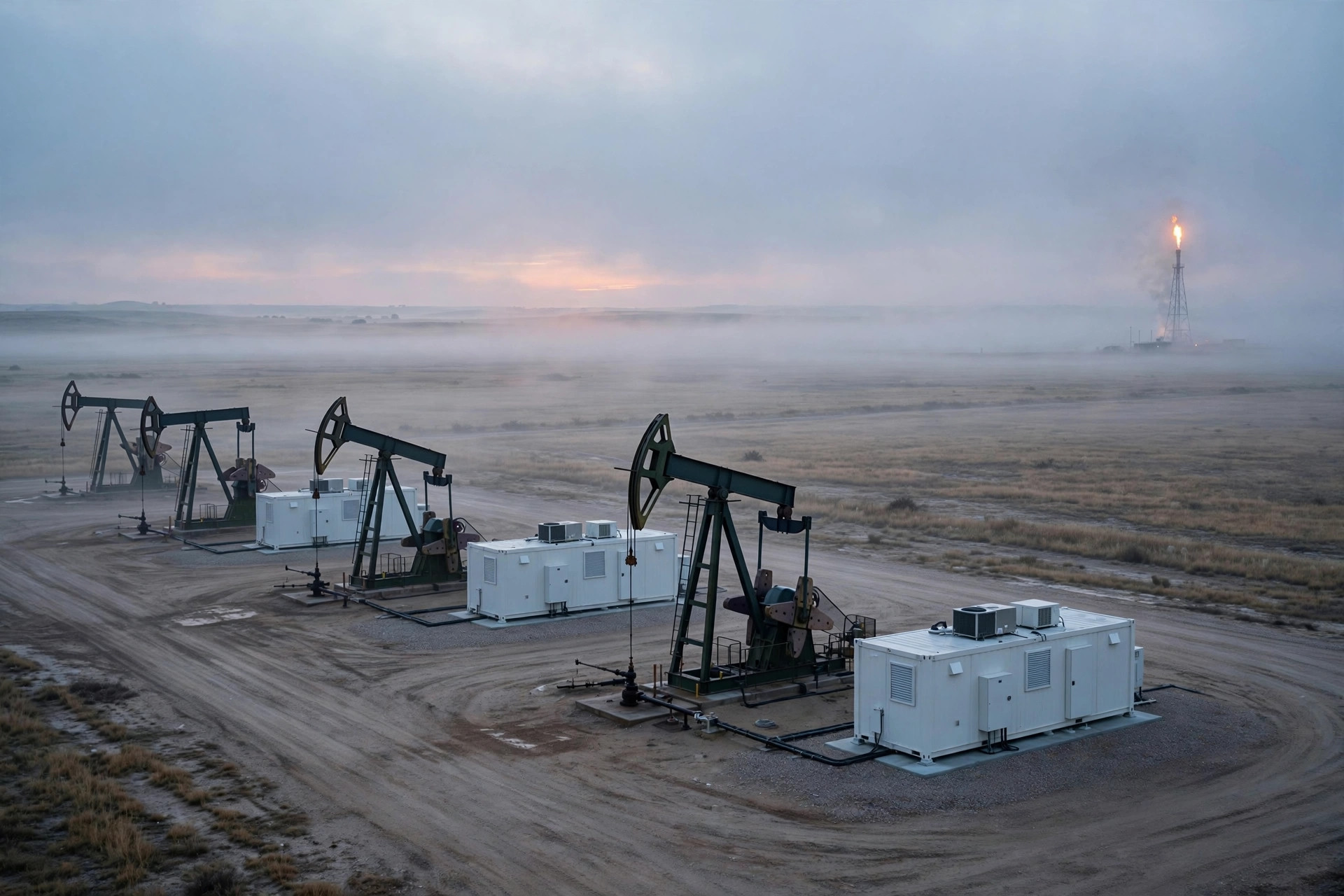
Crusoe is the closest thing this industry has to a proof of our thesis, which is exactly why it’s worth studying carefully. Founded in Denver in 2018 by Chase Lochmiller and Cully Cavness, the company began with a simple observation: oil wells were burning gas nobody could sell, and compute needed power nobody could get permitted. Their answer was Digital Flare Mitigation, modular data centers parked at the wellhead that turned flare gas into electricity and electricity into Bitcoin hashes.
That origin business is gone. In March 2025 Crusoe sold the flare-mining operation, including 425+ modular data centers, to NYDIG and completed a deliberate pivot into what it now calls “the AI factory company.” The through-line survived the pivot: build compute where the energy is, not where the grid is congested.
How the money works now
Crusoe’s revenue comes in four flavors. First, Crusoe Cloud, its GPU cloud: on-demand and reserved VMs and Kubernetes for AI labs, priced per GPU-hour (third-party trackers put H100s around $2.2–2.9/hr, with 30–45% discounts on 1–3 year commits; treat those as reference, not quotes). Second, long-term capacity leases, the whale business: the 1.2 GW Abilene, Texas campus, the first operational Stargate site, was developed by Crusoe and financed through a $15B joint venture with Blue Owl Capital, with Oracle as tenant serving OpenAI. Third, energy monetization: stranded-gas mitigation turned into firm power sales. Fourth, managed AI-factory services: design, build, and operate for hyperscalers.
The mix has shifted fast. AI cloud was roughly 45% of 2024 revenue (about $124M of ~$276M total), and outside estimates put 2025 revenue near $1B on the back of the Abilene buildout. Those are estimates, not audited figures. The funding trajectory tells the same story: Series D $600M at $2.8B (Dec 2024), Series E $1.375B at $10B+ (Oct 2025, Fidelity/Valor/NVIDIA/Mubadala), and a $3.9B Series F announced on their homepage this year.
The model is replicating: a 900 MW adjacent Abilene campus for Microsoft with an onsite power plant, and a 1.8 GW campus in southeast Wyoming with Tallgrass designed to scale toward 10 GW.
The technology worth studying
Strip away the marketing and Crusoe has two real technical assets. The first is the energy layer: co-developing generation (gas turbines, behind-the-meter power) alongside the data center shell. That compresses time-to-power, which is the binding constraint in the AI buildout. Everything else is downstream of that.
The second is operational range. The same company that ran hundreds of unmanned modular boxes on well pads now commissions gigawatt campuses. That span, from 1 MW skid to 1.2 GW campus, is rare. Most builders live at one end or the other.
Note the adjacent data point: Intel has been pushing the same modular logic from the silicon side, co-developing a 20-foot liquid-cooled modular data center container with Fourier. Stationary, not mobile like Crusoe’s wellhead units, but the same bet: factory integration beats field construction.
What to borrow, what to doubt
Borrow the structure: energy-first siting, vertical integration of power and compute, modular deployment as the default. These are the parts of Crusoe’s playbook that survive contact with arithmetic.
Doubt the brochure numbers. Crusoe advertises PUE of 1.2 to 1.3, energy costs “up to 30% lower,” deployment “up to 20x faster” and “81% cost cuts.” Those are vendor claims, useful as reference points, not facts. And watch the concentration risk: in 2026 Oracle/OpenAI dropped a planned 600 MW Abilene expansion, and Crusoe re-leased the capacity with NVIDIA reportedly putting down a $150M deposit while Meta circled. Gigawatt capacity is liquid right now, which cuts both ways.
The honest summary: Crusoe proved that flare gas can bootstrap a compute business and that energy-first development scales to gigawatts. It did not prove that the unit economics work without hyperscaler tenants writing 15-year leases. Anyone copying the model, including us, should know which half they’re copying.
Sources: company site (crusoe.ai); Financial Times via SiliconANGLE on the $1.3B raise; Sacra revenue estimates; third-party startup breakdowns. Company marketing claims noted as such.
← All articles